
Related News
- 00
0000-00
Which Third-Party Test Reports Are Required for Smart Meter Tenders? - 00
0000-00
Are Destination-Dispatch Moving Walks Reliable Under Heavy Traffic? - 00
0000-00
How Should MEP Teams Resolve Elevator–Fire System Interface Conflicts? - 00
0000-00
Which NFPA Codes Apply to Smart Metering in US Commercial Buildings? - 00
0000-00
Should Hospital MEP Designs Specify Redundant Cooling Towers?

In most hospitals, redundant cooling towers should be considered whenever the condenser-water system supports clinical cooling that cannot be interrupted for an extended repair, cleaning cycle, fan failure, basin problem, or water-treatment event. The appropriate answer is rarely a simple “yes” to duplicate every tower. It depends on which loads are connected, how much cooling can be shed without affecting care, whether chillers can operate at reduced capacity, and whether a single common component could still disable every tower.
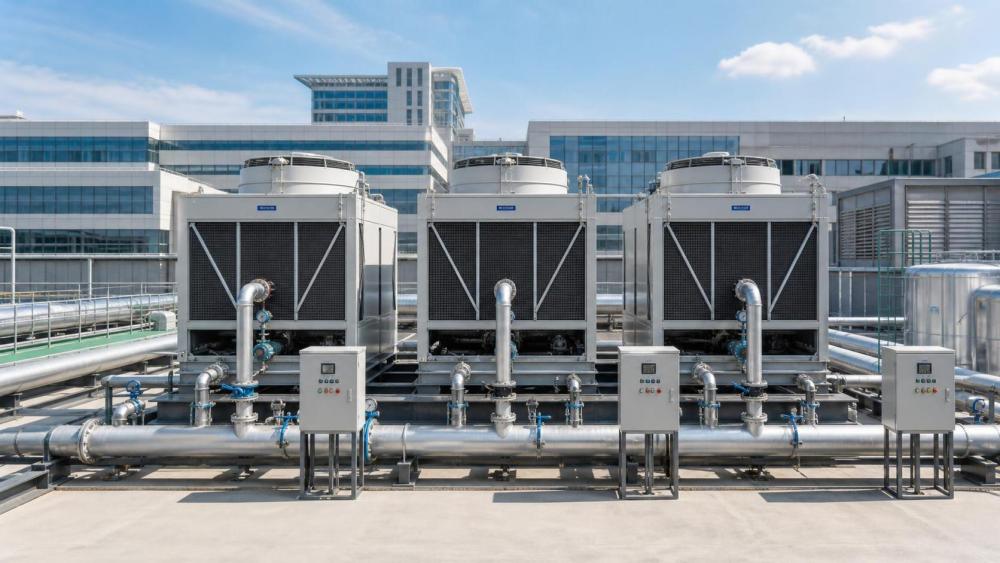
Cooling towers are part of a larger heat-rejection path: chiller, condenser-water pump, piping, tower cell, fan system, controls, makeup water, blowdown, and electrical distribution. A spare tower cell has limited value when all cells depend on one vulnerable pump header, one controller, one electrical feeder, or one accessible roof route. Hospital MEP design should therefore define redundancy at the system level rather than treating the tower schedule as an isolated equipment selection.
Start with the consequence of losing condenser-water capacity
Hospitals contain spaces with very different tolerance for temperature drift. An administrative area may accept temporary load reduction. Surgical suites, imaging areas, pharmacies, laboratories, isolation spaces, equipment rooms, and critical IT functions may have stricter environmental or equipment-temperature requirements. Some cooling demand also remains during mild weather because it comes from internal gains rather than outdoor conditions.
The design team should map each chiller plant load to an operational consequence. This exercise distinguishes the cooling capacity that must remain available during a fault from capacity that can be curtailed, transferred, or restored later. It also avoids applying the same redundancy rule to a general outpatient building and a central plant serving acute-care functions around the clock.
A useful early question is: Should I specify cooling towers with redundant units in a hospital MEP design? The answer is generally affirmative when the plant is expected to retain its required critical cooling output during the loss of the largest practical tower component. That component may be a full tower, one modular cell, a fan assembly, a basin section, a condenser-water pump, or a shared control panel.
Redundancy has several workable forms
“Redundant towers” can describe very different arrangements. The selection should be stated in terms of duty, standby capacity, operating condition, and outage scenario.
- N+1 cells: The required design heat rejection is met with one cell unavailable. This is often practical where several factory-assembled cells share a basin or where a tower is divided into independently isolable sections.
- Two duty-capable tower groups: Separate groups may be served by separate pumps, electrical sections, and headers. This provides stronger separation, although it requires careful hydraulic balancing and more site area.
- Oversized duty capacity: A smaller number of towers can retain the required load after one unit is removed. The approach may reduce equipment count, but a large individual unit creates a larger single failure event and can be difficult to replace.
- Emergency operating capacity: The available plant after a failure is sufficient only for defined essential loads. This can be acceptable when load-shedding sequences, room priorities, and operating limits are explicitly documented.
An N+1 arrangement is often confused with complete resilience. It only addresses the failure mode used in the calculation. If one common condenser-water supply header passes through the same valve pit, a header rupture can defeat every nominally redundant cell. Similarly, tower cells powered from separate starters may still be lost together if the upstream distribution section is unavailable.
Capacity calculations need realistic operating conditions
Cooling tower capacity should not be selected solely from nominal chiller tonnage. Heat rejection includes the evaporator cooling load plus compressor energy, so condenser heat rejection is higher than the building cooling load. The exact relationship varies with chiller type, lift, load, condenser-water temperature, and operating conditions. The tower selection must align with the chiller manufacturer’s permitted entering condenser-water temperature, flow range, and minimum flow requirements.
Design wet-bulb conditions, tower approach, and range drive the required tower size. A redundancy calculation should use the same outdoor design basis across the duty and outage cases. If the remaining cells can only meet the target at a lower chiller load, the design documents should say so and identify the loads that will be reduced. Assuming a tower will simply “work harder” during a peak condition can obscure the actual loss of chiller capacity.
Part-load behavior matters as well. Multiple cells with variable-speed fans may control condenser-water temperature efficiently during moderate conditions, but staging must avoid excessive fan cycling, low condenser-water temperatures outside chiller limits, or stagnant water in an idle cell. Tower controls should be coordinated with chiller sequencing, pump speed control, bypass arrangements, and winter operating logic.
Separate failures from planned maintenance
Maintenance is one of the strongest reasons to provide extra tower capacity in healthcare plants. Basin inspection, fill replacement, fan gearbox or motor work, drift eliminator repairs, nozzle cleaning, valve servicing, and cleaning associated with water-management practices can require a cell to be isolated. If taking a cell out of service causes a loss of required cooling at the most demanding outdoor condition, the facility is dependent on deferred maintenance, a temporary cooling connection, or a fortunate weather window.
Isolation should be physically possible without draining or contaminating the remaining operating sections. Each cell generally needs accessible isolation valves, drain points, venting where required, strainers or screens that can be serviced, and safe access to fan decks and internal components. Shared cold-water basins deserve particular attention. A shared basin can simplify construction, but maintenance or leakage in one area may affect the water volume, cleanliness, or access of adjoining cells.
Specifications should also clarify whether capacity is required with a cell under maintenance, with a fan out of service, or with an entire tower assembly unavailable. Those are materially different requirements. A single fan may not remove the same amount of heat-rejection capacity as the whole cell, especially where airflow distribution, fill arrangement, and plume control components are interdependent.
Water quality and infection-control exposure affect the arrangement
Open recirculating cooling towers require disciplined water treatment and monitoring. Stagnant zones, neglected standby cells, poor basin turnover, inadequate filtration, fouling, scaling, corrosion, and uncontrolled biological growth can reduce thermal performance and increase health-related concerns. Redundancy can improve maintainability, but it can also add basin volume and branch piping that must be managed properly.
Design details should support the site water-management program. These may include accessible sampling points, side-stream filtration connections, clearly routed bleed-off, reliable makeup-water metering, chemical-feed connection points, basin sweep provisions where appropriate, and drainage that does not create uncontrolled discharge. The water-treatment specialist should review the expected materials, water chemistry, operating temperature range, makeup quality, and periods of low load before tower procurement is finalized.
Material selection is tied to this review. Galvanized steel, stainless steel, fiberglass-reinforced components, PVC fill, and coated structural elements each respond differently to site atmosphere, treatment chemistry, cleaning methods, and physical handling. A hospital near a marine environment, industrial emissions, or severe freeze-thaw exposure may require a different enclosure, basin, fastener, and coil strategy than an inland project. Material substitutions made after award can alter corrosion resistance, cleaning compatibility, dead load, and expected maintenance needs.
Shared infrastructure can erase the value of a standby tower
Redundant cooling towers need matching attention to pumps, piping, power, controls, and make-up water. A practical review often follows the condenser-water path from each chiller to the tower and back again. At every common point, ask whether a failed valve, electrical component, sensor, pipe section, or control command can remove all available heat rejection.
Independent pumping is not always necessary for every project, but pump redundancy and maintainable valving are usually central to a credible resilience strategy. Pump failure, seal leakage, motor issues, variable-frequency drive faults, and blocked strainers can stop condenser-water flow even when standby tower capacity is available. The hydraulic design also needs to maintain required flow through operating chillers while avoiding excessive flow through isolated or idle branches.
Electrical resilience should examine feeder routing, local disconnects, starters or drives, automatic transfer arrangements where applicable, and the controls network. A tower fan can be mechanically sound yet unavailable because an interlock is not reset after a fault or a shared controller has failed. Hardwired safety functions, alarm annunciation, manual local control, and BAS points should be coordinated so that a temporary manual operating mode is possible when the supervisory system is impaired.
Location and installation constraints matter early
Roof-mounted towers introduce structural, acoustic, wind, access, and replacement issues. The support steel must account for operating weight, maintenance loads, vibration isolation, pipe movement, and the possibility that one cell is drained while adjacent cells remain full. Crane access is often overlooked until replacement fill, fan assemblies, or an entire tower section must be lifted over an occupied hospital.
Air recirculation is another common design error. Warm, moisture-laden discharge air can be drawn back into tower intakes when units are too close to parapets, walls, neighboring equipment, or one another. Recirculation raises entering air wet-bulb conditions and reduces effective heat rejection, precisely when peak performance is needed. Layout review should consider prevailing wind, discharge elevation, plume behavior, nearby outdoor-air intakes, exhaust outlets, and service clearances rather than relying on a footprint drawing alone.
Factory performance selection should be matched to the final installation geometry. Field conditions such as restricted air paths, excessive sound attenuation, louver pressure drop, or elevated discharge obstacles can change performance. Any need for low-sound fans, vibration isolation, plume control, or winter basin protection should be included in the basis of design instead of left as an unfunded late-stage option.
Write the specification around operating intent
A robust specification describes the required outcome and the evidence needed to verify it. It should identify the design heat-rejection duty, the number of cells required in operation, the capacity remaining after the stated outage, allowable condenser-water temperatures, fan control method, construction materials, access provisions, electrical characteristics, water-treatment interfaces, and instrumentation.
Submittals should show certified or otherwise documented thermal selection data at the stated conditions, fan motor and drive details, basin configuration, connection sizes, operating and shipping weights, sound data, control sequence interfaces, and maintenance access dimensions. Shipping splits deserve attention where rooftop lifting or narrow delivery routes limit module size. A tower that meets thermal duty on paper may be impractical to transport, rig, assemble, or replace within the available site constraints.
Controls documentation should include lead-lag rotation, failed-fan alarm response, sensor failure behavior, high condenser-water temperature alarms, low-temperature protection, cell isolation status, and the sequence used when capacity is limited. The sequence should state whether remaining chillers unload, whether nonessential loads are shed, and how normal operation is restored after maintenance.
Commissioning should test the degraded modes
Startup confirmation of normal fan rotation and water flow is not enough. Functional testing should simulate a tower cell being unavailable, a fan fault, a pump transfer where provided, loss of a supervisory control signal, and the return of equipment to service. Trend records can reveal unstable staging, unexpected condenser-water temperature rise, short cycling, or insufficient response to increasing load.
Seasonal testing may be necessary because full tower performance cannot always be demonstrated at the time of initial commissioning. The documentation should preserve the assumptions used for the resilience calculation and record any temporary operating limitations. Maintenance staff need clear isolation and restart procedures, particularly where chemical treatment, basin cleaning, or freeze protection changes the normal sequence.
Frequently asked questions
Is one standby cooling tower enough?
It may be enough if the remaining towers can reject the required heat at the stated design condition and the common pumps, headers, power supplies, controls, and water systems do not create a single point of failure. A standby unit without isolable piping or usable pumping capacity is not meaningful redundancy.
Can existing towers be made redundant during a retrofit?
Often, but the limiting factor may be roof structure, electrical capacity, condenser-water piping, chiller controls, or crane access rather than the new tower itself. A field survey should verify dimensions, operating weights, connections, clearances, available valve locations, and the condition of existing water-treatment infrastructure.
Should every hospital load remain online after a tower failure?
That depends on the defined clinical and operational requirements. A documented emergency cooling mode may prioritize critical functions while reducing nonessential loads. The important point is that the available tower capacity, chiller capacity, and control sequence agree with that priority plan.
Redundant cooling towers are justified when they preserve the cooling duty that the hospital cannot safely defer. The final design should demonstrate that this duty survives both equipment isolation and the shared-system failures most likely to occur in the actual plant layout.